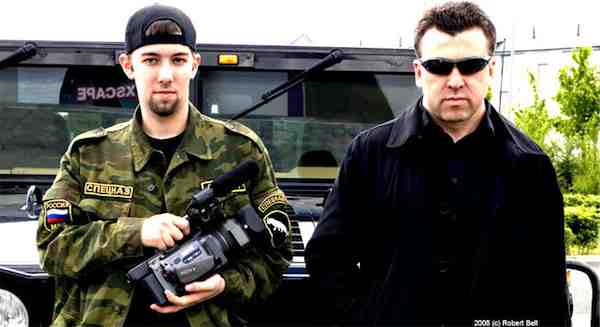
Grant Timmins and David Baker, in character for Mission X.
This is part 2 of our interview with David Baker, producer/writer/director/editor of the massively ambitious Mission X.
We were excited to talk with David because he’s developed so many of the skills we look for in Hands-On Producers.
In part 1, You Can Make and Distribute a Movie Yourself, David talked about his decision to go it alone, even though his previous movie was funded and distributed–an endgame most indies dream about.
In the interview, it became clear quick that David speaks his mind. He continues his refreshingly brutal honesty in this part of our story.
David, for a while, you were going to do a different film called Death Movie. What happened?
I had been looking for the money for Death Movie for three years, and I got lucky one day. My accountant knew two wealthy individuals who wanted to get into films. We made a presentation, and they commited within a week.
I was about a month from situating myself in LA, and the first £50,000 ($80,000) never came. The accountant told me they had to back out because some sort of “financial collapse” never before seen in all of history was about to hit! I thought he was bullshitting because they didn’t like a scene in the film or something! But the rest is history. A few weeks later, the banks were in trouble.
You’ve said this hit you hard. So, before making Mission X, you put together a checklist that would help you make a no-budget movie. What was that list? And your philosophy behind it?
It was a wake up call to my life. I knew my filmmaking pursuits were over if I didn’t adapt. And lets cut the bull, REAL filmmakers shoot with nothing! Wannabee filmmakers think they can’t do it unless they have lots of money.
I studied the guys I admired. Robert Rodriguez, Chris Nolan, Kevin Smith, and a little film called “The Magician” by Scott Ryan.
One night, I decided to shoot the film myself, over many months, or even a year if I had to. I had nothing to lose anymore. I could not go back to looking for money–that’s a really dumb approach when you’re just starting out. It’s best just to go make something.
Mission X: A story about a documentary film student who follows a mercenary recruiting for a mission, only to learn the mission is right in his own back yard. Why this film?
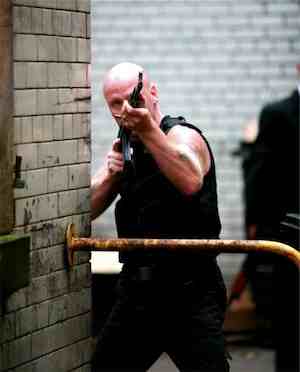 First of all, with no budget, I think you need the right style of movie to make it work. I saw so many MySpace filmmakers who were making films with £100, but the film had aspirations of being a 100m blockbuster, so right away it looks cheap, crap (unless you are REALLY talented, then you make “INK” like @DoubleEdgeFilms.) Overall, don’t make a movie that has aspirations to be a blockbuster if you have no budget.
I needed a story that would NOT work with top cameras, composers, name actors, great lighting, etc. A film that was meant to be real, gritty, dirty, kinda battered looking. I like films where you just follow interesting characters, like Taxi Driver. Or the way you just hang out with Tarantino’s characters to get to know them. People like following characters.
I wanted to show I could write strong three-dimensional characters. A lot of filmmakers can’t. I had several years experience as an actor, and I have written scripts for about ten years now, so I actually find it very easy to write dialouge.
At the same time, I wanted to show I could direct thrills and spills, some wild action, with no money.
Following in the footsteps of filmmakers like Christopher Nolan, Robert Rodriguez, Kevin Smith, and Peter Jackson, just to name a few, you decided to fund your movie yourself. What was your budget?
My first day’s shoot budget was £35 ($56.) Most of that went for food, petrol money. I had the people, I had the kit, props, etc, so it was really the basics. It went on like that for about 5 months. Wages from my McDonald’s job.
They say an army marches on it’s stomach. You should NEVER not feed people. Well, EVERYBODY was so into the film, that many days they brought their own food. It’s like a cardinal sin, I know you at LEAST feed people.
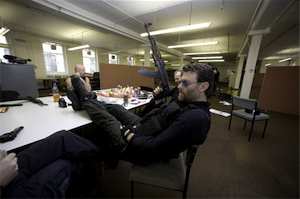 I kinda played the card that these guys have to get in character. Mercenaries can survive in the wild eating bugs if they have to. So I think I kind of got away with the lack of food using that “method” attitude! Haha! Nobody wanted to moan about the lack of food when they were walking around playing bad assed mercs!
In total, film was about £5000 ($8,000.) I also bought a computer, hard drives with that.
How did you manage to film all-out warfare in the middle of the city with no money?
This is the only area I had to be REALLY sensible with. Ten years ago, I might have done it guerilla style, but today, with an armed response in 4 mins, you would have to be an idiot not to get permission. (Might seem obvious, but I worked in student films in London, and we tried to film gun scenes in the city with no permission all the time.)
I went straight to the top armourer in Scotland. He worked on a recent mercenary horror film “Outpost”, and “Doomsday”. I was honest with him. I offered a cut of the film, like I did with everybody, but we all know that is not a great incentive these days. I saw he did not have a website, so I offered to build him one as payment.
 Getting him on board helped wth the police a lot, since he knew the police film unit well. I dont think anybody has shot AK-47’s in the city. Not in films anyway! So I had to convince a chief inspector I knew what I was doing. He agreed to it if I told all the residents and businesses in the area.
I only had £40 ($65) in my pocket for this big action scene that day. People thought it cost thousands.
The shooting style of Mission X is very stylized. You say you were inspired by real videos of urban battle in Iraq?
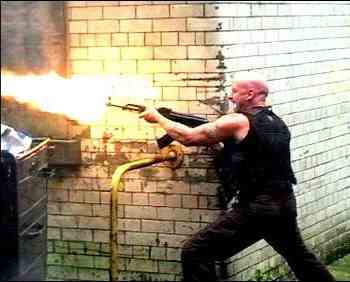 Absolutely! I watched them when writing the script. You can’t shoot good action when you have no money. But as I watched the Iraq videos, I noticed you don’t really see the enemy. Just them firing from the distance, and the aftermath. I think a lot of times it’s what you “dont see” that adds to scenes. This also helps in a no budget film when you can’t afford many “enemy.” So, a budget problem actually added to the creativity.
The Iraq videos were a perfect template for shooting action reality style.
What camera choices were inspired by watching those videos?
At first, I had no cameras, no crew, no props–so I had no choices. I owned a mobile phone with video on it. I was so desperate, I even considered shooting the whole movie on that phone. But as the weeks went on, I met people with all sorts of camera kits. They offered them for free to help me out.
Grant (who plays the film student) had his own Sony PD150. An old battered camera. But it worked perfectly. Films like “Inland Empire” “24 Hour Party People” and “Open Water” used cameras like that. We tested it in low light conditions, and it held up well.
Plus, going with this kind of “method” attitude, it worked: it was Grant, it was his camera. So we just kept it that way. I also had 7 other cameras in the underground shoot out. Consumer cameras and flip cams, to represent multiple pov witnesses. I had a lot of students shooting from different positions for that day.
Stay Tuned for Part 3…
In which David discusses techniques he used to combine actors with non actors, and so much more. You won’t want to miss it. Be sure to follow us on twitter or to subscribe to our feed to catch the rest of David’s brutally honest interview, filled with great tips you can steal!